American Thoracic Society 2019 (ATS 2019) International Conference
Jury still out on optimal treatment for mild, low-eosinophil asthma
2019-07-11
Treatment with the ICS* mometasone or the LAMA** tiotropium did not significantly improve outcomes over placebo in patients with mild, persistent asthma presenting with low eosinophil levels, the SIENA*** study finds, thus calling for a reconsideration of the convention that all patients with persistent asthma should receive ICS.
“Guidelines recommend the use of inhaled glucocorticoids in all patients with persistent asthma … according to the belief that airway inflammation is ubiquitous in asthma and, if untreated, leads to airway remodelling,” explained the researchers. “[However,] approximately 50 percent of patients [with] mild, persistent asthma may not be associated with sputum eosinophilia.”
Eosinophils are key mediator of type 2 airway inflammation and sputum eosinophil level has been shown to predict response to glucocorticoids. “Patients with a low level of type 2 airway inflammation do not have a favourable response to inhaled glucocorticoids,” noted the researchers.
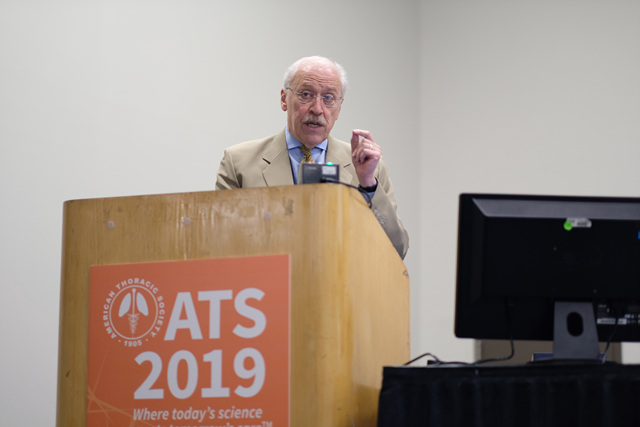
In the double-blind crossover SIENA trial, the majority of patients with mild, persistent asthma and low sputum eosinophil levels (<2 percent) showed no significant difference in their response to either mometasone or tiotropium compared with placebo, reported lead author Dr Stephen Lazarus from the University of California, San Francisco, in San Francisco, California, US during the ATS 2019 Congress. [N Engl J Med 2019;380:2009-2019]
However, this does not mean that these patients should junk ICS right away, according to Lazarus, who said there simply isn’t enough data as of now to support this.
“Our results raise the question of whether treatment guidelines should be re-evaluated for patients with mild, persistent asthma for whom evidence of type 2 inflammation is lacking,” said Lazarus.
The clinical equipoise
Of the 295 patients with mild, persistent asthma aged ≥12 years (mean age 31 years), 73 percent had low sputum eosinophil levels (<2 percent) based on two sputum samples collected 3–6 weeks apart, which exceeded the 50 percent prevalence initially anticipated.
The patients were randomized to receive tiotropium 5 μg once daily, mometasone 220 μg twice daily, or placebo twice daily for 12 weeks before crossing over to the other treatment group. They were stratified according to their sputum eosinophil levels.
Among patients with a low eosinophil level, the response rate to mometasone was not significantly different from that to placebo (57 percent vs 43 percent; p=0.14) in terms of a hierarchical composite outcome of treatment failure, asthma control days, and FEV1#.
Although response to tiotropium was better compared with placebo (60 percent vs 40 percent; p=0.029), the p-value did not reach the prespecified <0.025 needed to be considered statistically significant.
The response to mometasone was, not surprisingly, significantly better than to placebo (74 percent vs 26 percent) among patients who had a high eosinophil level, which was driven mainly by an increase in FEV1. In contrast, no statistical difference was seen in response to tiotropium vs placebo among these patients (57 percent vs 43 percent).
“The results showed that a high percentage of patients with persistent asthma had a low eosinophil level in the sputum and challenge the recommendation of the use of regular inhaled glucocorticoids in all patients with persistent asthma,” wrote Dr Gary Wong of the Chinese University of Hong Kong, Hong Kong in an accompanying editorial. [N Engl J Med 2019;380:2064-2066]
“When considering maintenance therapy for persistent asthma, one must be aware that not all types of airway inflammation respond equally well to inhaled glucocorticoid therapy,” he added. “The SIENA trial clearly showed that a large group of patients with persistent asthma might not have eosinophilic airway inflammation, and thus, inhaled glucocorticoid therapy would not be the best treatment for them.”
Still in search of optimal therapy
Lazarus highlighted that not only is the use of ICS associated with an increased cost of maintenance treatment among patients with low-eosinophil asthma, there may also be an increased risk of side effects.
“Although our data for patients in the low-eosinophil stratum do not support current treatment recommendations, the appropriate controller treatment for these patients remains to be determined,” said Lazarus and co-authors.
“These data provide equipoise for a clinically directive trial to compare an inhaled glucocorticoid with other treatments in patients with a low eosinophil level,” he said, suggesting that a larger, longer trial be conducted in the future to shed more light on how best to treat these patients. Biomarkers used to guide treatment in severe asthma may also provide insights to help select patients with mild asthma who are most likely to respond to therapy.
| 이전글 | FSSG questionnaire aids in diagnosis of GERD-related cough |
|---|---|
| 다음글 | Long-term use of benralizumab efficacious, safe for severe, uncontrolled asthma |


