European Society of Cardiology (ESC) Congress 2016
Platelet function monitoring does not benefit elderly patients stented for ACS
2016-10-17
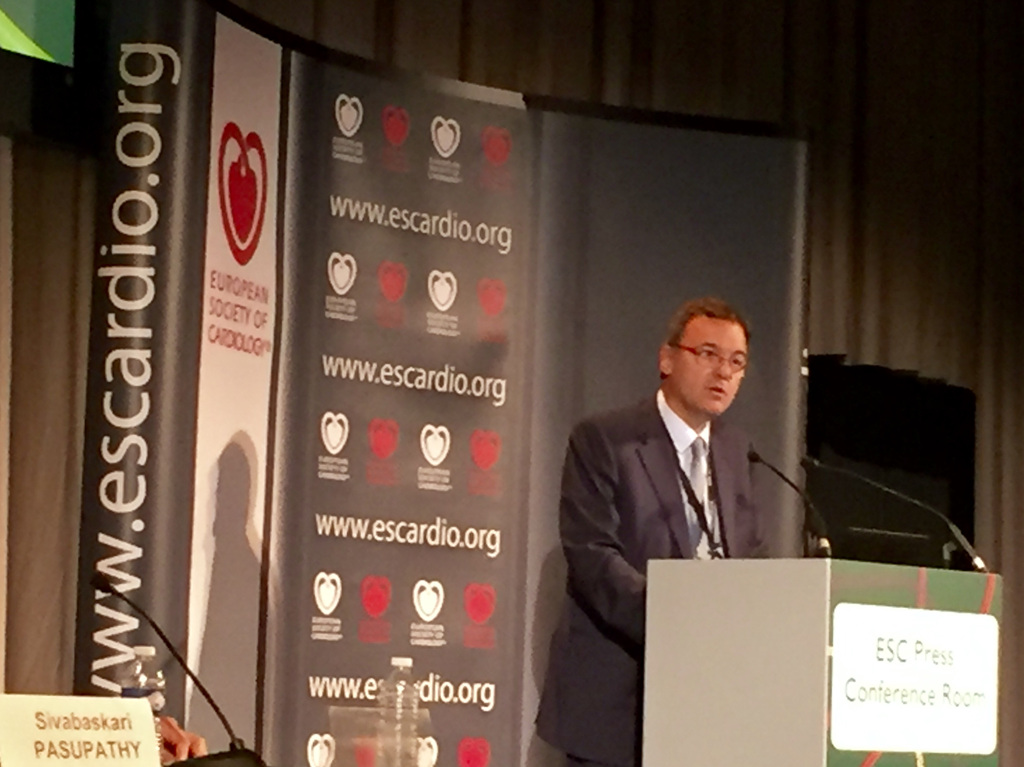
Monitoring platelet function to individualize antiplatelet therapy does not improve outcomes in elderly patients who have undergone urgent PCI for acute coronary syndrome (ACS), new data presented at the European Society of Cardiology Congress 2016 have shown.
“In this largest randomized PCI study in an elderly population, no difference was seen in rates of the primary composite endpoint of cardiovascular death, MI, stroke, stent thrombosis, urgent revascularization and bleeding complications at 1 year between patients who underwent platelet function monitoring and those who did not,” said Professor Gilles Montalescot of the Hôpital Pitié-Salpêtrière in Paris, France, senior investigator of the ANTARCTIC study. [Lancet 2016, doi: http://dx.doi.org/10.1016/S0140-6736(16)31323-X]
All 877 patients (age, ≥75 years) in the study were started on prasugrel 5 mg/day after PCI. In those randomized to undergo monitoring, platelet reactivity testing was performed 14 days after randomization. Therapy was adjusted to prasugrel 10 mg/day for patients with high platelet reactivity (≥208 P2Y12 reaction unit), while those with low platelet reactivity (≤85 P2Y12 reaction unit) were treated with clopidogrel 75 mg/day instead. Additional platelet function monitoring was performed 14 days after treatment adjustment.
“At 1 year, the primary composite endpoint occurred in 27.6 percent of patients in the monitoring group vs 27.8 percent of patients in the conventional therapy group who received no platelet function monitoring [hazard ratio (HR), 1.003; p=0.98],” said Montalescot.
Similarly, no between-group difference was seen in the key secondary composite endpoint of cardiovascular death, MI, stroke, stent thrombosis and urgent revascularization (9.9 vs 9.3 percent; HR, 1.06; p=0.80).
The rate of bleeding events also did not differ significantly between patients who received platelet function monitoring and those who received conventional treatment (HR, 1.04; p=0.77).
“Although platelet function monitoring led to a change of treatment in 44.8 percent of patients identified as being over- or under-treated, this strategy provided no improvements in ischaemic or safety outcomes,” said Montalescot.
“Our findings do not support the international guideline recommendations and practice of platelet function monitoring in high-risk patients. This costly and more complex approach does not appear to benefit patients, even when they present with an extremely high risk of ischaemic and bleeding events like those enrolled in the ANTARCTIC study,” he added.
ANTARTIC is the fifth randomized controlled study that has shown negative results on individualized antiplatelet therapy based on platelet function monitoring. For East Asian patients who receive dual antiplatelet therapy for ACS or after PCI, the World Heart Federation does not recommend routine platelet function testing because the rate of ischaemic events is similar or even lower in East Asian patients despite their higher level of platelet reactivity compared with Caucasian patients. [Nat Rev Cardiol 2014;11:597-606]
| 다음글 | Prasugrel and ticagrelor show similar efficacy and safety in STEMI |
|---|


