European Society for Medical Oncology (ESMO) Asia 2016 Congress
Increasing trend in HPV-related cancers seen in Asia, highlights importance of vaccination
2017-01-23
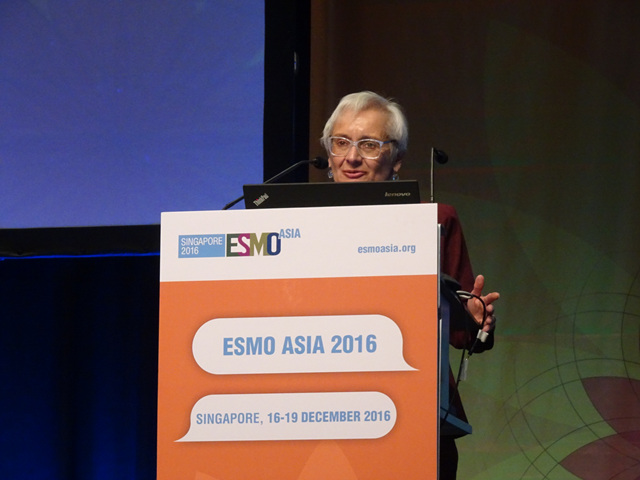
In Asia, an increase in the burden of cancers related to human papillomavirus (HPV) infection is expected owing to demographic and behavioural changes, including sexual habits; thus, efforts are directed towards introducing HPV vaccination in low-incidence populations and increasing availability of more affordable vaccines for high-risk HPV types 16 (HPV16) and 18 (HPV18), according to Dr Silvia Franceschi of the World Health Organization’s International Agency for Research on Cancer (IARC) in Lyon, France.
In a discussion on HPV and HPV-related cancer in Asia at the recent ESMO Asia 2016 Congress in Singapore, Dr Franceschi presented global and regional data on the prevalence of cancers associated with HPV infection, particularly oropharyngeal and cervical cancer.
“Asia alone accounts for approximately half of new cancer cases, cancer deaths and prevalent cases in the world, and this situation is not going to get any better because of a number of demographic and epidaemiologic transitions that are currently taking place,” said Dr Franceschi.
According to her, changes in sexual habits and in the number of children per women are important factors that play a role in the observed trends for HPV infection and HPV-related cancers.
Dr Franceschi presented incidence, prevalence and mortality data from the IARC’s GLOBOCAN 2012 project, noting that while there is enormous variation in rates across regions and countries, majority of cancer cases due to HPV are female.
“Overall, the percentage of cancer in females due to HPV is 9 percent but with peaks of one cancer out of five in sub-Saharan Africa and about 20 percent in Asia, the Pacific islands and Latin America,” she said.
Apart from cervical cancer, the discussion also included global and regional data on oropharyngeal cancer (OPC), which is also known to be associated with HPV infection.
“Contrary to cervical cancer which is entirely caused by HPV, head and neck cancer has a sort of double nature,” said Dr Franceschi, referring to the two main types of OPC: HPV-induced OPC and OPC related to smoking and tobacco use.
“The increased interest that we are seeing in this topic is mainly due to the fact that in Western countries such as in North America and Northern Europe, there has been a concomitant decrease in smoking,” she added.
For Dr Franceschi, HPV-induced OPC is a new phenomenon that is not very accurately quantified in many countries.
“For instance, the United States and some North European countries are the only ones that have really shown trends of cancer of the oropharynx by HPV status,” she said. “They have shown over time that the proportion of cancer of the oropharynx in which functional HPV infection can be found has increased.”
Although data on the presence of HPV in reported cases of OPC are currently limited, inferences may be drawn from trends in the incidence of OPC versus other head and neck cancers. Dr Franceschi noted that in studies by Chaturvedi and colleagues, there is an upward trend for OPC and a decline in cases of oral cavity and larynx in the US, whereas in many countries, both OPC and non-OPC cancers are increasing. [J Clin Oncol 2011;29:4294?4301; J Clin Oncol 2013;31:4550-9]
Head and neck cancer cases attributable to both sexes appear to be less frequent in low- and middle-income countries. Ranges of HPV positivity are 13 to 60 percent for OPC compared to 1.4 to 4.3 percent and 1.1 to 4.6 percent for oral cavity and laryngeal cancers, respectively. Also, 80 percent of head and neck cancers attributable to HPV occur in males with approximately 30,000 cases per year. [Lancet Glob Health 2016;4:e609?16]
“The attributable percent by site varies enormously for oropharynx, much less for oral cavity and larynx because the association with HPV is indeed very weak,” she said.
Geographically, the trend observed for cervical cancer is similar to that seen in head and neck cancer which, according to Dr Franceschi, is influenced by the lack of penetration of cervical cancer screening in those parts of the world.
Dr Franceschi said that based on GLOBOCAN 2012 data, cervical cancer is the second or third most common cancer in Asia. “But the fact that liver and lung cancer are very frequent doesn’t mean cervical cancer is rare,” she said, adding that there are extremely high-risk countries like Mongolia, Cambodia and India where the incidence of cervical cancer is over 20 per 100,000 women.
Opposite trends are noted for breast and cervical cancer, with an increase in breast cancer cases and a decline in cervical cancer. According to Dr Franceschi, reproductive activity plays a role in cervical cancer in that “the more children you have and the earlier the first child, the higher the risk of cervical cancer as a cofactor of HPV infection,” she said.
Varying trends are seen across countries and regions; a general decreasing trend is seen for cervical cancer in Asia, but a Japan birth cohort shows that there is an increase in HPV infection in women born later, which Dr Franceschi attributed to two factors.
“First, screening is probably not totally adequate; many countries speak about a ‘screening fatigue’. Second, the relatively younger women are already reflecting the consequences of the substantial change in sexual behaviour especially in young age,” she said.
The implementation of national vaccination programmes has been done in Bhutan and Malaysia but is not yet widespread in Asia. In Singapore, Dr Franceschi observed there is a recommendation to vaccinate females aged 9 to 26 years, which may offer some benefit “but it has not yet been made into a public health programme, which is the way vaccination should be done because it is meant to prevent disease in a community, not only in an individual.”
She added that to maximize the benefits of HPV vaccination, at least 70 to 80 percent of individuals must be vaccinated to eliminate the spread of infection in the population.
Dr Franceschi also cited obstacles to effective HPV vaccination implementation in Asia, which include the very high cost of vaccines, the need for import, unjustified fears and false reports of side effects, and the misconceptions that HPV vaccines distributed in Asia are less effective.
Lastly, Dr Franceschi explored the apparent association between sexual behaviour in young people and and control of HPV infection.
“Age at first intercourse and type of partnership in young people are the main drivers of the spread of HPV,” she said, citing findings from a study by Baussano and colleagues showing that transition from traditional to “modern Western” sexual behaviour increases HPV16 prevalence by >2.5-fold particularly in women aged 20 to 34 years, and that early introduction of vaccination may reduce HPV16 prevalence and risk of infection. [Emerg Infect Dis 2016;22:18?23]| 이전글 | Nivolumab better maintains quality of life and symptom control vs docetaxel in advanced NSCLC |
|---|---|
| 다음글 | Latest developments on breast cancer treatments |


