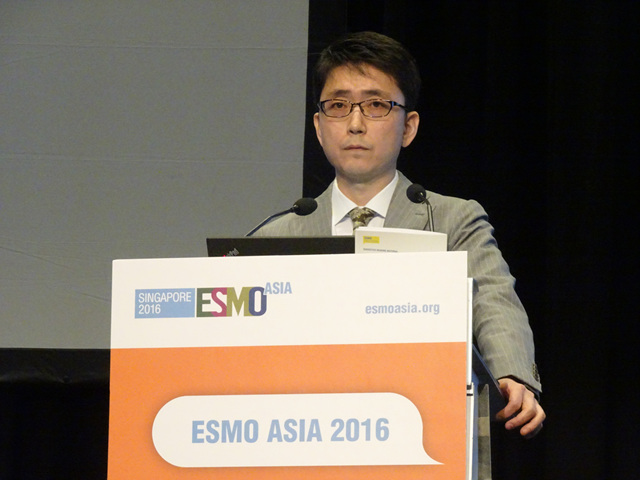
Pembrolizumab at a dose of 200 mg every three weeks is safe and improves survival in Asia-Pacific patients with recurrent or metastatic head and neck squamous cell carcinoma (HNSCC), based on findings of the KEYNOTE-012* trial presented at the European Society for Medical Oncology (ESMO) Asia 2016 conference, held in Singapore.
In a subset analysis for Asia-Pacific patients (n=26, median age 61.5 years, 85 percent male), median overall survival (OS) was higher in the Asia-Pacific patients (11.6 months, 95 percent confidence interval [CI], 4.7?17.3 months) compared with the overall cohort (8.4 months, 95 percent CI, 5.7?10.2 months). [ESMO Asia 2016, abstract 359O_PR]
The OS rates were also higher at 6 months and 12 months in the Asia-Pacific group compared with the overall cohort (58.5 percent vs 57.2 percent at 6 months and 46.0 percent vs 36.8 percent at 12 months).
The overall response rate was similar between the Asia-Pacific patients and the overall cohort (19.2 percent, 95 percent CI, 6.6?39.4 percent vs 18.2 percent, 95 percent CI, 12.0?25.8 percent), while the disease control rate was better in Asia-Pacific patients (50.0 percent) than in the overall trial population (37.9 percent).
“Although the experience in Asia-Pacific patients is limited, the efficacy was generally similar between the Asian and overall population,” said Dr Makoto Tahara, Chief of the Division of Head and Neck Medical Oncology at the National Cancer Center Hospital East, Kashiwa, Japan, who presented the results.
The most frequently experienced treatment-related adverse events reported were fatigue (19.2 percent vs 22 percent), decrease in appetite (19.2 percent vs 9.1 percent), and hypothyroidism (15.4 percent vs 10.6 percent) in the Asia-Pacific vs overall population, respectively.
In this nonrandomized, phase 1b, multicohort trial, a total of 132 patients with recurrent or metastatic HNSCC were administered the highly selective, humanized monoclonal IgG4 antibody against PD-1, pembrolizumab, at a dose of 200 mg Q3W for 24 months or until disease progression or intolerable toxicity.
The median duration of response was not reached in either cohort. In the overall population, 91 percent of responses lasted for ≥6 months and 86 percent of responses lasted for ≥12 months, compared with the Asia-Pacific responses which were 80 percent in both time frames. Sixty-one percent of the overall population experienced tumour shrinkage compared with 50 percent of the Asia-Pacific population.
According to Tahara, more than half of the total HNSCC cases worldwide occur in the Asia-Pacific region, and prognosis of recurrent and metastatic HNSCC is poor with a median OS of 10 and 6 months in previously untreated and treated patients, respectively. [N Engl J Med 2008;359:1116-1127; J Clin Oncol 2009;27:1864-1871]
Phase III trials investigating the clinical benefit of pembrolizumab 200 mg Q3W vs standard of care chemotherapy are ongoing globally and include patients from the Asia-Pacific region, said Tahara.


