International Association for the Study of Lung Cancer (IASLC) 18th World Conference on Lung Cancer (WCLC)
PD-L1 testing to guide first-line pembrolizumab use in NSCLC: Cost-effective in HK
2017-12-12
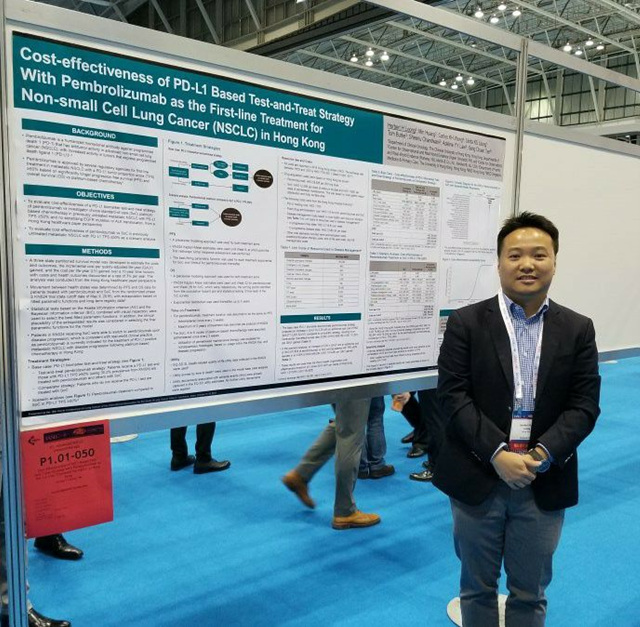
PD-L1 biomarker testing to guide the use of pembrolizumab in first-line treatment of metastatic non-small-cell lung cancer (NSCLC) is cost-effective from a Hong Kong healthcare payer perspective, according to results of a study presented at the 18th World Conference on Lung Cancer (WCLC) held recently in Yokohama, Japan.
In the study, researchers from the Chinese University of Hong Kong (CUHK), The University of Hong Kong and MSD evaluated health economic outcomes with a PD-L1 biomarker test-and-treat strategy involving pembrolizumab in first-line treatment of metastatic NSCLC in patients with no sensitizing EGFR mutation or ALK translocation.
“Under the PD-L1 biomarker test-and-treat strategy, patients received PD-L1 testing, and those with a PD-L1 tumour proportion score [TPS] of ≥50 percent were treated with pembrolizumab, while those with a PD-L1 TPS of <50 percent were given investigator’s choice of standard-of-care platinum-based chemotherapy,” reported lead investigator Dr Herbert Loong of the Department of Clinical Oncology, CUHK. “This strategy was evaluated against a comparator strategy, in which patients who did not receive PD-L1 testing were treated with standard-of-care platinum-based chemotherapy [ie, base case analysis].”
The investigators also evaluated the cost-effectiveness of first-line pembrolizumab treatment vs standard-of-care platinum-based chemotherapy in patients who had a PD-L1 TPS of ≥50 percent (ie, scenario analysis).
In both analyses, health economic outcomes were evaluated in a cohort simulation model using progression-free survival (PFS), overall survival (OS) and time-on-treatment data from the phase III KEYNOTE-024 trial, as well as disease management costs based on drug prices in Hong Kong and costs of healthcare resource utilization in the Hospital Authority (HA) in 2016.
“In the base case analysis, the PD-L1 biomarker test-and-treat strategy involving first-line pembrolizumab treatment was associated with a projected gain of 0.29 quality-adjusted life-years [QALYs] with an additional cost of HKD 249,077 [USD 32,015] vs the comparator strategy,” reported Loong. “This translated into an incremental cost-effectiveness ratio [ICER] of HKD 865,189 [USD 111,207] per QALY gained, which is below the WHO cost-effectiveness threshold of three times the gross domestic product per capita of Hong Kong in 2016 [ie, HKD 1,017,819 or USD 130,825].”
The total cost of the test-and-treat strategy with pembrolizumab was HKD 1,147,792, while that of the comparator strategy was HKD 898,715.
“In the scenario analysis, pembrolizumab was associated with a gain of 0.95 QALYs and an additional cost of HKD 817,829 vs platinum-based chemotherapy among patients with a PD-L1 TPS of ≥50 percent. This translated into an ICER of HKD 859,284 [USD 110,448] per QALY gained,” Loong continued.
These findings are similar to those from a recent study in the US, which demonstrated cost-effectiveness of pembrolizumab vs standard-of-care platinum-based chemotherapy as first-line treatment in patients with metastatic NSCLC with a PD-L1 TPS of ≥50 percent. In the US study, pembrolizumab was associated with an expected gain of 1.05 QALYs vs chemotherapy and an incremental cost per QALY gain of USD 97,621. [PharmacoEconomics 2017;35:831-844]
| 이전글 | Patients on durvalumab, placebo report similar quality of life |
|---|---|
| 다음글 | Socioeconomic factors influence OS in NSCLC |


