Singapore Prevention & Cardiac Rehabilitation Symposium (SPCRS) 2017
eHealth and telemedicine: Promising future applications
2017-12-12
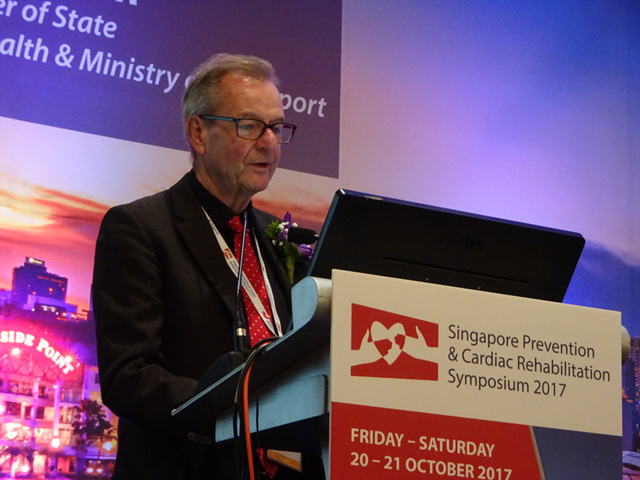
eHealth and telemedicine can be effective in providing innovative solutions to healthcare problems, said Professor Hugo Saner during the Singapore Prevention & Cardiac Rehabilitation Symposium (SPCRS) 2017 in Singapore.
The increase in mobile health applications has set higher expectations in the medical community, with some perceiving these solutions as a ‘magic bullet’ that could immediately solve problems, Saner added.
Expectations range from decreasing the burden of disease by prevention, improving healthcare delivery and experience of care for individuals living with chronic diseases, and encouraging a more customized and patient-centric approach at a reduced cost.
Nonetheless, health and fitness applications had a lower monthly engagement rate than social network applications (number of times the applications were opened for 5 minutes in a month, 12.7 vs 25.1), which highlights the issue of adherence, said Saner. “Adherence is a big issue. It may be interesting to have a new app but after a few weeks, [users might] lose interest.”
Both eHealth and telemedicine aim to bridge the gap created by the shortage of healthcare professionals and the increasing demands for medical care, said Saner. Using a cloud-based platform, eHealth and telemedicine can consolidate large-scale data from multiple centres under one system, a process referred to as “data mining”, according to Saner.
With the huge amount of data consolidated through eHealth and telemedicine solutions, electronic health records can be conveniently accessed, enabling clinicians to better identify patients and develop the appropriate treatment strategy, Saner said, adding that “[this could] be a large part of research in the future using data from electronic health records.”
However, he emphasized that these systems are not designed to replace human interaction, as some clinicians and patients fear that they might be confined to screens when communicating.
“We should not see eHealth and telemedicine as the magic bullet. We should have realistic expectations … There are great challenges [and] technical potential … [but] there is no real impact yet,” said Saner. “[We might need] a few more years until we can really take advantage of the full potential of all these technical tools.”
“[From] the statement of the European Union … promises of these new technologies to increase efficiency, to improve quality of life, and to unlock innovations in health markets remain largely unfulfilled. We have more expectations than reality,” Saner added.| 이전글 | Discharge instruction improves cardiac patients’ medication knowledge, compliance |
|---|---|
| 다음글 | Elderly patients less likely to correctly manage angina symptoms post-PCI |


